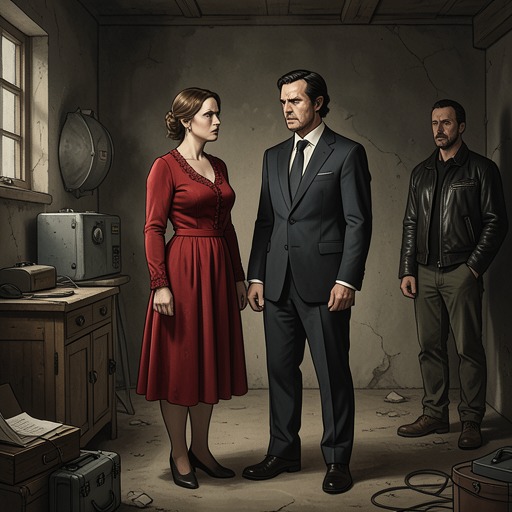
Reading of Red Muldoon’s Will and Landon’s Threat
The OutlawsThe Reading of Red Muldoon’s Will and Landon’s Threat turns the settlement of an estate into a new source of danger. Judge Bailey’s reading confirms that Kate Muldoon inherits Patrick Muldoon’s property, while Max Landon’s place at the Diamond M Ranch depends on Kate’s choice. Landon responds not by accepting the conditions but by challenging the will and threatening Del Delaney, making the legal announcement a direct confrontation over authority, employment, and Kate’s safety.
The Reading and the Estate
Judge Bailey conducts the reading in his office with Kate, Landon, and Del present. Landon has initially hesitated at the door, but Bailey insists that Del represents Kate and may stay if she wants him there. Kate takes a chair beside Landon, while Del remains by the window. The arrangement places the people affected by the will together as Bailey prepares to make its terms public.
Bailey takes a long envelope from a drawer, removes a single sheet, smooths it, and puts on gold-rimmed spectacles before reading. The careful handling of the document gives the scene a formal, evidentiary character: the decision is not presented as rumor or an informal promise, but as written instructions whose terms Bailey can explain and defend. He describes Red’s will as simple and says its intentions are clear.
The estate consists of personal possessions and two principal assets: the ranch and savings accounts, along with money in a checking account used for the Diamond M’s operating expenses. Bailey notes that Landon has had access to that checking account and therefore knows its balance, though Bailey himself does not know the current amount. The detail distinguishes the estate’s long-term property from funds already connected to the ranch’s day-to-day operation, and establishes that Landon has had practical access to at least part of its finances.
What the Will Provides
In the document, Patrick Muldoon, also known as Red Muldoon, leaves his property, land, livestock, and cash to his daughter, Katharine Ann Muldoon. Landon is described as someone who had been like a son to Red, but the will does not give him immediate ownership. Instead, Red expresses the wish that Kate continue to employ him as foreman and that he become a full partner in time. The distinction is consequential: Kate receives the estate, while Landon’s proposed advancement depends on her employing him and on a future partnership that has not yet taken effect.
The will also names Landon as the recipient of the entire estate if Kate dies. That provision makes his future interest conditional on her death, rather than a present share alongside hers. Bailey’s explanation underscores the contrast between Red’s expressed affection for Landon and the legal structure he chose: Landon is offered a possible future within the ranch, but Kate holds the inheritance and the immediate authority to decide whether Landon remains foreman.
Bailey makes that authority explicit. If Kate does not want to employ Landon, he must leave the premises within twenty-four hours. Bailey adds that, in view of Landon’s recent attempts to murder Kate, she is legally and morally justified in refusing to keep him. The will therefore does not require Kate to preserve Landon’s position, even though Red had expressed the wish that she do so. Its practical effect is to put the decision in her hands.
Landon’s Challenge and Threat
Landon accuses Bailey of having written the will himself and claims that Red could not have made such a document while of sound mind. Bailey rejects the accusation without losing his composure. He says that he would have drafted a different will, but that Red was strong-minded and had come to him almost a year earlier with specific instructions about what he wanted and how he wanted it expressed. Bailey says he wrote the will accordingly, had it witnessed, and filed it. His account directly answers Landon’s challenge by presenting the document as the result of Red’s considered directions and a formal process.
Landon rises, trembling with anger, refuses to accept the demand that he vacate the ranch, and turns his hostility toward Del. He threatens that Del will never leave town alive. The threat shifts the scene from a dispute about the will’s validity and the right to remain at the Diamond M into a personal danger for Kate’s representative. Landon then leaves the office, slamming the door. His departure ends the exchange, but does not resolve the conflict: he has rejected the judge’s authority and made his opposition explicit.
Consequences and Significance
After Landon leaves, the room falls silent. Del tells Bailey that the will is an invitation to murder. Bailey acknowledges that he had warned Red about that danger, but says Red became angry at the suggestion that Landon might harm Kate. The exchange establishes that the risk was not invisible to Bailey: the will’s arrangement had been recognized as dangerous even before the reading, yet Red rejected the warning.
Kate bows her head and cries silently. Her reaction follows the announcement of her inheritance, the revelation that Landon’s place is conditional, and his threat against Del; the scene does not reduce the will to a simple transfer of property. It leaves Kate with legal control but also with the immediate burden of a decision made urgent by Landon’s hostility. The reading confirms what Red intended, while Landon’s response shows how little the written terms alone can settle. Bailey can establish the will’s validity and Kate’s right to dismiss Landon, but the threat makes clear that legal authority and personal safety are not the same thing.